
Nepal travel guide for Indians 2026–27
Plan Kathmandu, Pokhara, Chitwan, Lumbini and Muktinath: ID rules for Indians, currency, best time, road and air routes, how many nights and what our trips cost.
By the Agrima Holidays Team · Updated October 2026 · 6 min read
Why go
Nepal is the easiest foreign trip for most Indians. You need no visa and no passport. Indian rupees work in many places. The food, festivals and temples feel close to home, and the Himalaya rises right behind them.
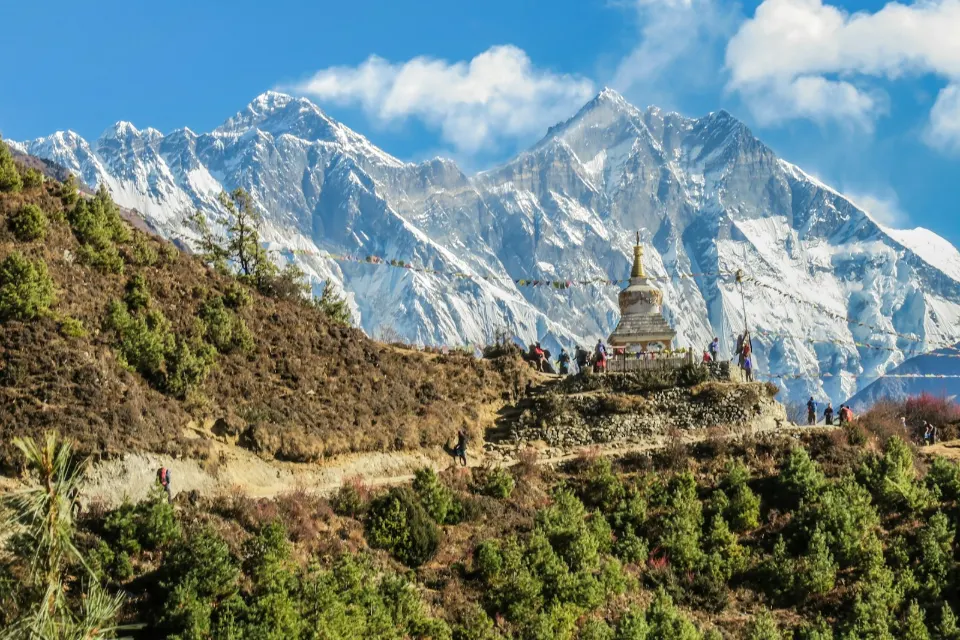
In a week you can see the temples of the Kathmandu valley, watch sunrise over the Annapurna range from Sarangkot, take a jungle safari in Chitwan and visit Lumbini, the birthplace of the Buddha.
ID and entry
Indian citizens need no visa for Nepal. Carry one of these for every traveller:
- A valid Indian passport, or
- A voter ID card issued by the Election Commission of India
Aadhaar and PAN are not accepted as travel documents. Children under 15 can travel with a birth certificate or school ID. Children between 15 and 18 need a passport, voter ID or a certificate from the school principal.
If you fly, airlines check your ID at the gate. If you drive, the border post registers your vehicle.
Money
The Nepali rupee is fixed at about 1.6 to the Indian rupee. Indian notes of ₹100 and below are widely accepted. Rules on carrying higher Indian notes have changed in recent years. Carry smaller notes to be safe, and exchange the rest at banks.
UPI works at many shops and hotels in Kathmandu and Pokhara through linked apps. Cards work at larger hotels.
When to go
October and November are the best months. Monsoon rain has washed the air, skies are clear and the mountains stand out sharply. Dashain and Tihar, the biggest festivals, fall in these months.
March to May is the second season, with rhododendrons in bloom, warm days and some haze over the mountains.
December to February is cold, with clear days. Kathmandu nights drop close to freezing. Pokhara stays milder.
June to September is the monsoon. Clouds hide the peaks, landslides close roads, and flights to Jomsom cancel often.
Festivals:
- Dashain, in September or October, the biggest festival of the year
- Tihar, the Nepali Diwali, with the festival of lights and the worship of crows, dogs and cows
- Mahashivratri at Pashupatinath, with lakhs of pilgrims and sadhus
- Buddha Jayanti at Lumbini and Swayambhunath
- Indra Jatra in Kathmandu, in September
Month by month
| Month | Average temperature | Our trips that month |
|---|---|---|
| January | 2°C to 19°C | 4 of 5 packages |
| February | 4°C to 21°C | 4 of 5 packages |
| March | 8°C to 25°C | 5 of 5 packages |
| April | 11°C to 28°C | 5 of 5 packages |
| May | 16°C to 29°C | 5 of 5 packages |
| June | 19°C to 29°C | 1 of 5 packages |
| July | 20°C to 28°C | 1 of 5 packages |
| August | 20°C to 28°C | 1 of 5 packages |
| September | 18°C to 28°C | 2 of 5 packages |
| October | 13°C to 27°C | 5 of 5 packages |
| November | 7°C to 23°C | 5 of 5 packages |
| December | 3°C to 20°C | 4 of 5 packages |
Average night low to day high, from long-term climate averages. Higher places run colder.
How many nights
- 4 nights: Kathmandu and Nagarkot
- 5 nights: Kathmandu and Pokhara
- 6 nights: Kathmandu, Pokhara and Chitwan
- 7 nights: add Lumbini
- 6 to 7 nights: Pashupatinath and Muktinath yatra, with Pokhara
Kathmandu to Pokhara is about 25 minutes by air or 6 to 7 hours by road. Pokhara to Chitwan is about 5 hours by road.
Getting there
By air, Tribhuvan International Airport in Kathmandu has direct flights from Delhi, Mumbai, Kolkata, Bengaluru and Varanasi. Pokhara's new international airport has limited flights.
By road, the main crossings are:
- Sunauli, from Gorakhpur, the closest to Lumbini and Pokhara
- Raxaul and Birgunj, from Bihar, for Kathmandu and Chitwan
- Banbasa, from Uttarakhand, for the far west
- Kakarbhitta, from Siliguri, for the east
Indian vehicles need a permit at the border, issued per day. We handle the paperwork when our car crosses.
Kathmandu valley
The stops that appear most often in our Nepal itineraries:
- Kathmandu
- Pokhara
- Chitwan
- Nagarkot
- Jomsom
- Pashupatinath, one of the most sacred Shiva temples, on the Bagmati river. Only Hindus may enter the main temple. Evening aarti draws crowds
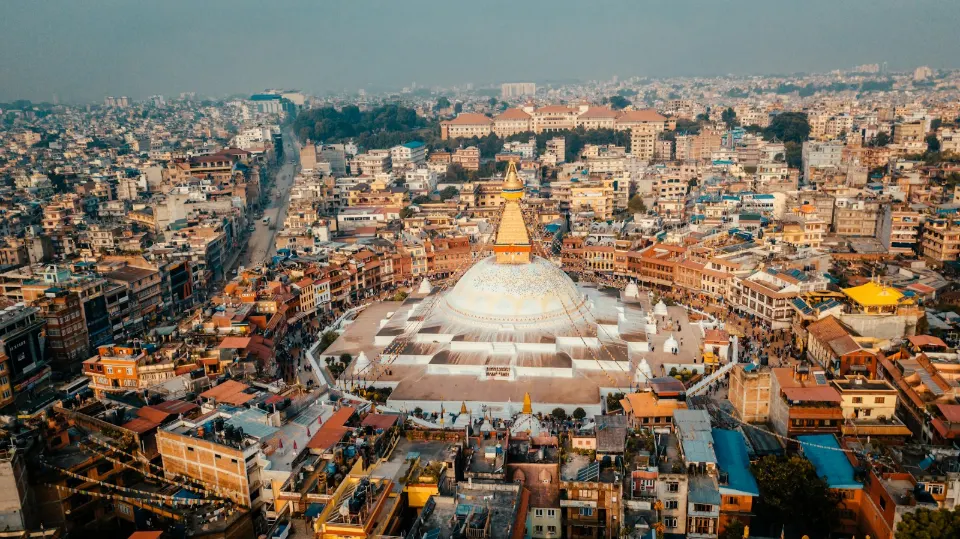
- Boudhanath, one of the largest stupas in the world, with Tibetan monasteries around it. Walk the kora in the evening
- Swayambhunath, the monkey temple, on a hill above the city
- Kathmandu Durbar Square, with the old royal palace and the house of the Kumari, the living goddess
- Patan Durbar Square, with the finest Newar temples and the Patan Museum
- Bhaktapur, a medieval town with squares, pottery workshops and juju dhau, king curd
- Budhanilkantha, a sleeping Vishnu in a pool
- Thamel for shopping and restaurants
The three Durbar squares and Swayambhunath and Boudhanath are part of a UNESCO site. Entry tickets are cheaper for Indian and SAARC visitors.
An Everest mountain flight leaves Kathmandu at dawn and flies along the high Himalaya for about an hour. Flights cancel in cloud. Keep a spare morning.
Nagarkot, about 1 hour 30 minutes east, gives sunrise views over the Himalaya in clear weather.
Pokhara
Pokhara sits on Phewa Lake with the Annapurna range behind. On clear mornings, Machhapuchhre, the fishtail peak, reflects in the water.
- Sunrise at Sarangkot
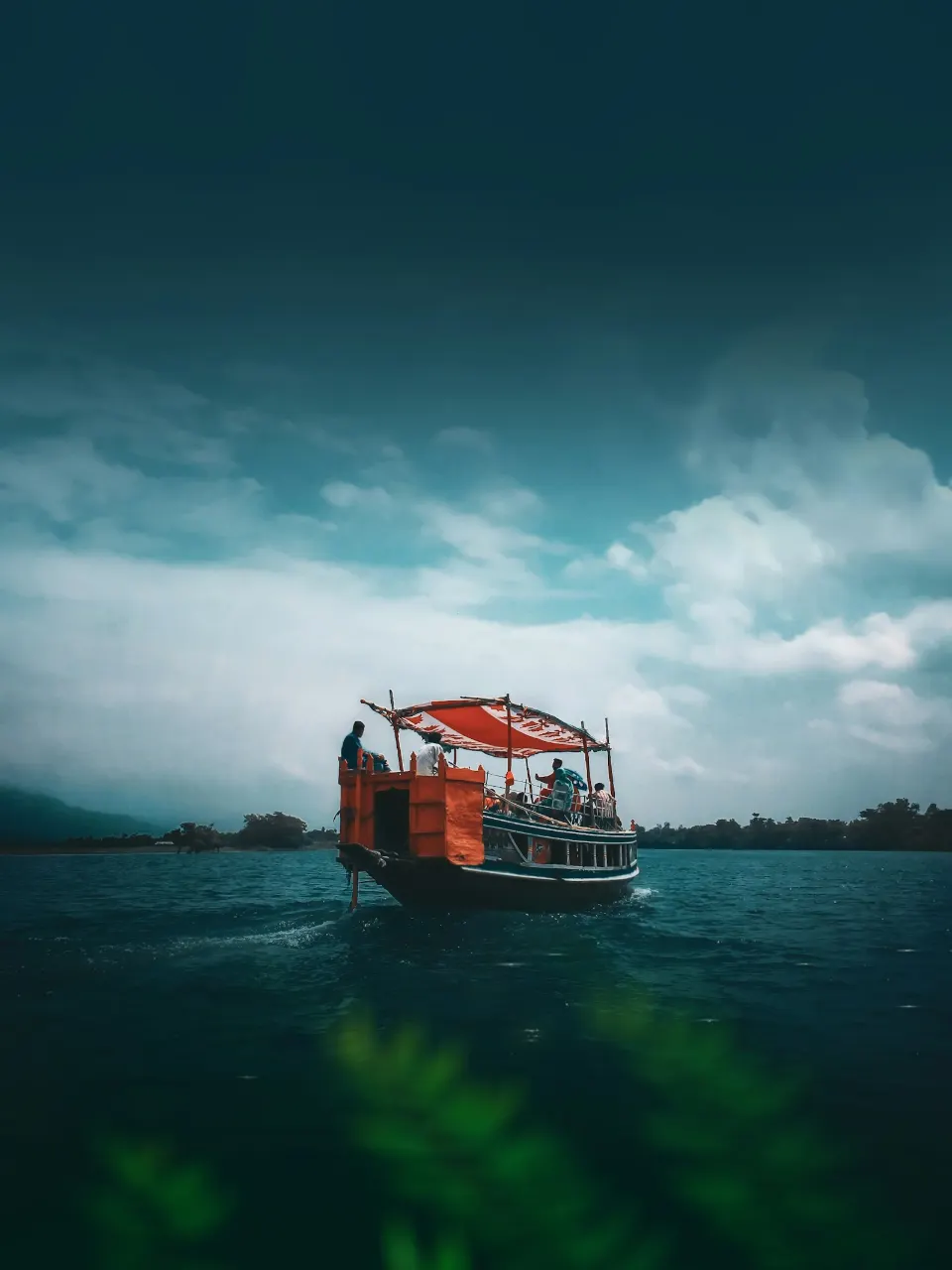
- Boat ride to the Tal Barahi temple on an island in the lake
- World Peace Pagoda, with a view over the lake and the mountains
- Davis Falls and Gupteshwor Mahadev cave
- Paragliding from Sarangkot, one of the best spots in the world
- Lakeside cafés and shops
The Manakamana cable car, on the road between Kathmandu and Pokhara, takes you up to a much-loved temple in 10 minutes.
Chitwan and Lumbini
Chitwan National Park, a UNESCO site in the lowlands, protects one-horned rhinos, Bengal tigers, gharials and over 500 bird species. Jeep safaris, canoe rides on the Rapti river and jungle walks with guides. Tharu village visits and cultural dances in the evening.
Lumbini, near the Sunauli border, is the birthplace of the Buddha. The Maya Devi temple marks the spot, beside the Ashoka pillar from the 3rd century BCE. Monasteries built by many countries stand in the development zone.
Muktinath
Muktinath, at about 3,800 m in Mustang, is sacred to both Hindus and Buddhists. Pilgrims bathe under 108 water spouts and in two ponds. The temple is one of the 108 Divya Desams of Vishnu.
Most pilgrims fly from Pokhara to Jomsom, a 20-minute flight through the gorge, then drive to Muktinath. Flights run only in the morning and cancel often in wind or cloud. Keep a spare day. A helicopter option is also available.
Altitude affects some travellers. Read our altitude sickness guide.
Food
- Dal bhat, rice with lentils, vegetables and pickle, the national meal
- Momos, steamed or fried
- Thukpa and thenthuk, noodle soups
- Newari food in Patan and Bhaktapur: bara, chatamari and yomari
- Juju dhau in Bhaktapur
Indian vegetarian food is easy to find in Kathmandu and Pokhara.
Our Nepal packages
| Package | Length | From, per person |
|---|---|---|
| Kathmandu & Nagarkot Short Break | 3N / 4D | ₹17,000 |
| Kathmandu & Pokhara | 5N / 6D | ₹25,000 |
| Pashupatinath & Muktinath Yatra | 5N / 6D | ₹34,500 |
| Nepal Honeymoon: Nagarkot & Pokhara | 6N / 7D | ₹30,000 |
| Nepal with Chitwan Safari | 7N / 8D | ₹32,000 |
Prices start from ₹17,000 per person on twin sharing, excluding flights.
Practical tips
- Carry a passport or voter ID for every adult
- Carry Indian notes of ₹100 and below
- Indian SIMs on roaming are expensive. Buy a local Ncell or Nepal Telecom SIM
- Power cuts are rare now, but carry a power bank
- Keep a spare day for any trip with a mountain flight or Jomsom
- Dress modestly at temples and remove shoes
Tell us if you want to drive from India. We plan the route through the border that suits your city.