
Madhya Pradesh travel guide 2026–27
Plan Khajuraho, Orchha, tiger reserves, Ujjain, Omkareshwar, Pachmarhi and Mandu: when to go, routes, safaris, how many nights and what our trips cost.
By the Agrima Holidays Team · Updated October 2026 · 6 min read
Why go
Madhya Pradesh sits in the middle of India and gets fewer visitors than it deserves. The state has more tiger reserves than any other, two jyotirlingas, the carved temples of Khajuraho and quiet fort towns like Orchha and Mandu.
Distances are long, so pick a theme. Wildlife, temples, or heritage, or combine two with a little more time.
When to go
October to March is the best time for most of the state. Days stay between 22 and 30°C. December and January nights drop close to 5°C in the parks.
April to June gets extremely hot, above 42°C. Tiger sightings improve as animals come to waterholes, but jeep safaris in the afternoon are tough.
The monsoon runs from late June to September. Core zones of the tiger reserves close from 1 July to 30 September. Pachmarhi and the Narmada valley look their best.
Festivals:
- Khajuraho Dance Festival, in February, on an open-air stage in front of the temples
- Simhastha Kumbh at Ujjain, once every 12 years, next due in 2028
- Mahashivratri at Ujjain and Omkareshwar
- Mandu Festival, in December or January
Month by month
| Month | Average temperature | Our trips that month |
|---|---|---|
| January | 10°C to 25°C | 11 of 11 packages |
| February | 13°C to 28°C | 11 of 11 packages |
| March | 17°C to 33°C | 10 of 11 packages |
| April | 22°C to 38°C | 6 of 11 packages |
| May | 27°C to 41°C | 6 of 11 packages |
| June | 25°C to 36°C | 6 of 11 packages |
| July | 23°C to 30°C | 4 of 11 packages |
| August | 22°C to 29°C | 4 of 11 packages |
| September | 21°C to 30°C | 4 of 11 packages |
| October | 18°C to 31°C | 10 of 11 packages |
| November | 13°C to 28°C | 11 of 11 packages |
| December | 10°C to 26°C | 11 of 11 packages |
Average night low to day high, from long-term climate averages. Higher places run colder.
How many nights
- 3 nights: Khajuraho and Orchha
- 3 nights: one tiger reserve, with four or five safaris
- 4 nights: Ujjain, Omkareshwar and Maheshwar
- 5 nights: Bandhavgarh and Kanha together
- 7 nights: Khajuraho, Orchha and Bandhavgarh or Panna
- 3 nights: Pachmarhi
Tiger reserves need a minimum of two nights. Sightings come with time.
Getting there
Bhopal, Indore, Jabalpur, Khajuraho and Gwalior have airports. Indore has the best connections.
By train, the Vande Bharat runs from Delhi to Rani Kamlapati station in Bhopal in about 8 hours, with stops at Agra, Gwalior and Jhansi. Jhansi is the station for Orchha, 18 km away. Katni and Umaria serve Bandhavgarh. Jabalpur serves Kanha and Bandhavgarh.
Khajuraho has a small station with trains from Delhi and Varanasi.
The tiger reserves
The stops that appear most often in our Madhya Pradesh & Chhattisgarh itineraries:
- Jagdalpur
- Kanha
- Pachmarhi
- Raipur
- Khajuraho
- Bhopal
- Bandhavgarh
- Barnawapara
Bandhavgarh has one of the highest densities of tigers in India. The Tala zone, with the old fort on the hill, is the most popular. Sightings in Tala are frequent in a good season.
Kanha is larger, with sal forest and wide meadows. The park protects the hard-ground barasingha, a deer saved from extinction here. Tigers are seen often in the Kanha and Mukki zones.
Pench, on the Maharashtra border, inspired The Jungle Book. Tigers, leopards and wild dogs are regular sightings.
Panna, close to Khajuraho, has gorges, waterfalls and a tiger population rebuilt from zero after 2009. Boat rides on the Ken river add another view.
Satpura allows walking safaris, canoe safaris and night drives in the buffer zone, unusual in India.
Safari permits sell online on the MP forest portal, by zone and time slot, up to 120 days ahead. Core zone permits for October to March sell out fast. Book with your trip.
Safari basics
- Two safaris a day: morning from sunrise for about four hours, and afternoon until sunset
- Six people per jeep, plus a driver and a guide
- Carry your ID. The name and number must match the permit
- Dress in muted colours. Carry a warm layer in winter mornings. Open jeeps get bitterly cold
- No plastic, no music, no getting out of the vehicle
- Core zones close on Wednesday afternoons in most parks, and fully from 1 July to 30 September
Khajuraho and Orchha
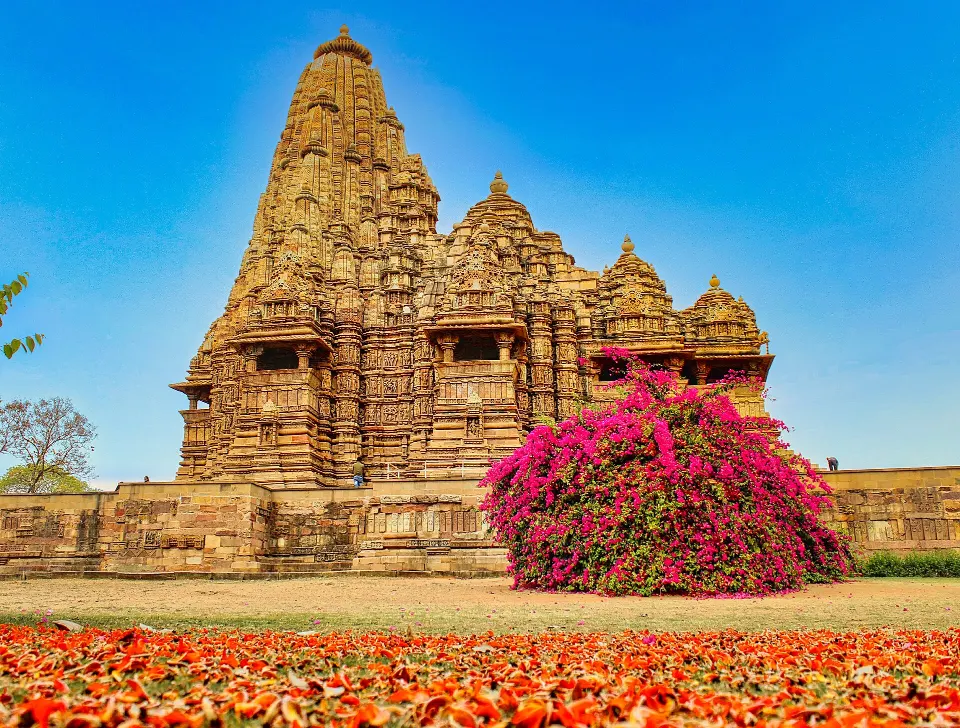
Khajuraho's temples were built by the Chandela kings between about 950 and 1050. Of the 85 temples built, about 25 survive. The Western Group, inside a landscaped park, holds the finest, including the Kandariya Mahadeva and Lakshmana temples. The carvings show gods, dancers, musicians, warriors and daily life. A small share are erotic.
Plan a full day with a guide. The light and sound show in the evening tells the story.
Orchha, on the Betwa river, was the capital of the Bundela kings. The Jahangir Mahal, Raja Mahal and the Chaturbhuj temple stand within a short walk. The Ram Raja temple is the only temple where Rama is worshipped as a king. Chhatris, royal cenotaphs, line the river and catch the sunset.
Khajuraho to Orchha is about 4 hours by road.
Ujjain, Omkareshwar and Maheshwar
Ujjain is home to the Mahakaleshwar Jyotirlinga. The Bhasma Aarti, performed before dawn with sacred ash, is the most sought-after ritual. Tickets sell online on the temple website and go fast. Dress code applies for the aarti: dhoti for men, saris for women.
The Mahakal Lok corridor, with murals and statues, leads to the temple. Visit the Kal Bhairav temple and Ram Ghat on the Shipra river.
Omkareshwar, 140 km away, is another jyotirlinga, on an island in the Narmada. The Statue of Oneness, a 108 ft statue of Adi Shankaracharya, stands on the hill above.
Maheshwar, on the Narmada, has the Ahilya fort and ghats, and is known for Maheshwari handloom saris.
Indore, the nearest airport, is famous for street food at Sarafa Bazaar and Chappan Dukan.
Mandu and Pachmarhi
Mandu, on a plateau above the Malwa plains, holds Afghan-era palaces and mosques. The Jahaz Mahal, built between two lakes, and Rani Roopmati's pavilion are the highlights. The town is best in the monsoon, when the plateau turns green.
Pachmarhi, at about 1,100 m in the Satpura range, is the only hill station in Madhya Pradesh. Waterfalls, caves with old rock paintings, and viewpoints like Dhoopgarh at sunset make two or three days. Some sights need a Gypsy, an open jeep, through the forest.
Bhopal and Sanchi
Bhopal, the state capital, has two large lakes, the Taj-ul-Masajid mosque and the Tribal Museum, one of the best museums in India.
Sanchi, 45 km away, holds the Great Stupa, commissioned by Ashoka in the 3rd century BCE, with carved gateways added later. Bhimbetka rock shelters, with paintings tens of thousands of years old, sit 45 km south. Both are UNESCO sites.
What to eat
- Poha and jalebi, Indore's breakfast
- Bhutte ka kees, grated corn cooked in milk
- Dal bafla, the Malwa cousin of Rajasthan's dal baati
- Bhopali biryani and kebabs
- Malpua and mawa bati for sweets
Our Madhya Pradesh and Chhattisgarh packages
| Package | Length | From, per person |
|---|---|---|
| Bandhavgarh Tiger Safari | 2N / 3D | ₹21,200 |
| Raipur & Sirpur Heritage | 2N / 3D | ₹10,400 |
| Barnawapara Wildlife Sanctuary | 2N / 3D | ₹11,400 |
| Orchha & Khajuraho | 3N / 4D | ₹17,300 |
| Ujjain Mahakal & Omkareshwar Jyotirlinga | 3N / 4D | ₹14,300 |
| Kanha Tiger Safari | 3N / 4D | ₹26,100 |
| Pachmarhi Hills | 3N / 4D | ₹13,800 |
| Bhopal, Sanchi & Mandu | 3N / 4D | ₹16,300 |
| Chitrakote Falls & Bastar | 3N / 4D | ₹15,300 |
| Mainpat Hills | 3N / 4D | ₹12,900 |
| Kanger Valley & Bastar Waterfalls | 3N / 4D | ₹14,300 |
Prices start from ₹10,400 per person on twin sharing.
Practical tips
- Book safari permits as soon as your trip is confirmed
- Carry binoculars and a long lens if you have one
- Winter mornings in an open jeep reach 3 to 5°C. Carry a jacket, cap and gloves
- Bhasma Aarti tickets in Ujjain open online about a month ahead
- Long drives are common. We plan rest stops and lunch on the way
Tell us your interests. We pick the parks and towns to keep drives short.